
Laser Vision Correction
LASIK Xtra in Singapore
LASIK Xtra is a standard LASIK procedure with one added step: corneal cross-linking, performed during the same surgery to add stability to the treated cornea.
It is offered as a surgeon-selected step for certain eyes, not as a routine upgrade for every patient. At Advanced Eye Clinic & Surgery, whether LASIK Xtra is likely to help is decided after your cornea has been assessed, by the same refractive surgeon who plans and performs your LASIK surgery in Singapore.
- Purpose
- Adds corneal cross-linking to LASIK, aiming to improve biomechanical stability in selected eyes
- What it does not do
- It does not sharpen or improve your vision beyond the LASIK itself
- Added time
- About two minutes on top of the LASIK
- Recovery
- In line with standard LASIK
- Suitability
- Decided after a full corneal assessment, per eye
- Cross-linking agent
- Riboflavin (Vitamin B2) activated by UVA light
On this page
What Is LASIK Xtra?
LASIK Xtra surgery is a LASIK procedure which includes the additional step of cross-linking the cornea during the LASIK surgery. It takes about two minutes in total on top of the normal LASIK surgery time.
The aim of LASIK Xtra eye surgery is similar to LASIK, which is to reduce spectacle or contact lens dependence. The vision correction itself comes entirely from the LASIK.
What the added cross-linking step is intended to do is different: increase the cross-linking within the treated corneal tissue, with the aim of improving its biomechanical stability. It does not give you a sharper result than LASIK alone, and patients should not expect better eyesight from choosing Xtra.
What it may offer, in the right eye, is more stability over time.
LASIK Xtra typically uses an accelerated cross-linking protocol, in which a higher UVA irradiance is delivered over a shorter period than conventional cross-linking. The formulation, energy delivered and exposure time vary between protocols.
Why Might Cross-Linking Be Added to LASIK?
To reshape the cornea, LASIK creates a flap and removes a small amount of tissue. This leaves the cornea thinner and somewhat less rigid than it was before. For most appropriately screened eyes, these changes do not lead to corneal instability or ectasia.
Suitability is based on more than thickness alone. The interest in adding cross-linking is concentrated in a smaller group of eyes where more tissue is removed or where the cornea is already on the thinner side, because the aim is to offset some of the biomechanical weakening associated with the surgery.
Two specific concerns sit behind the procedure, and they are not the same thing:
Corneal ectasia
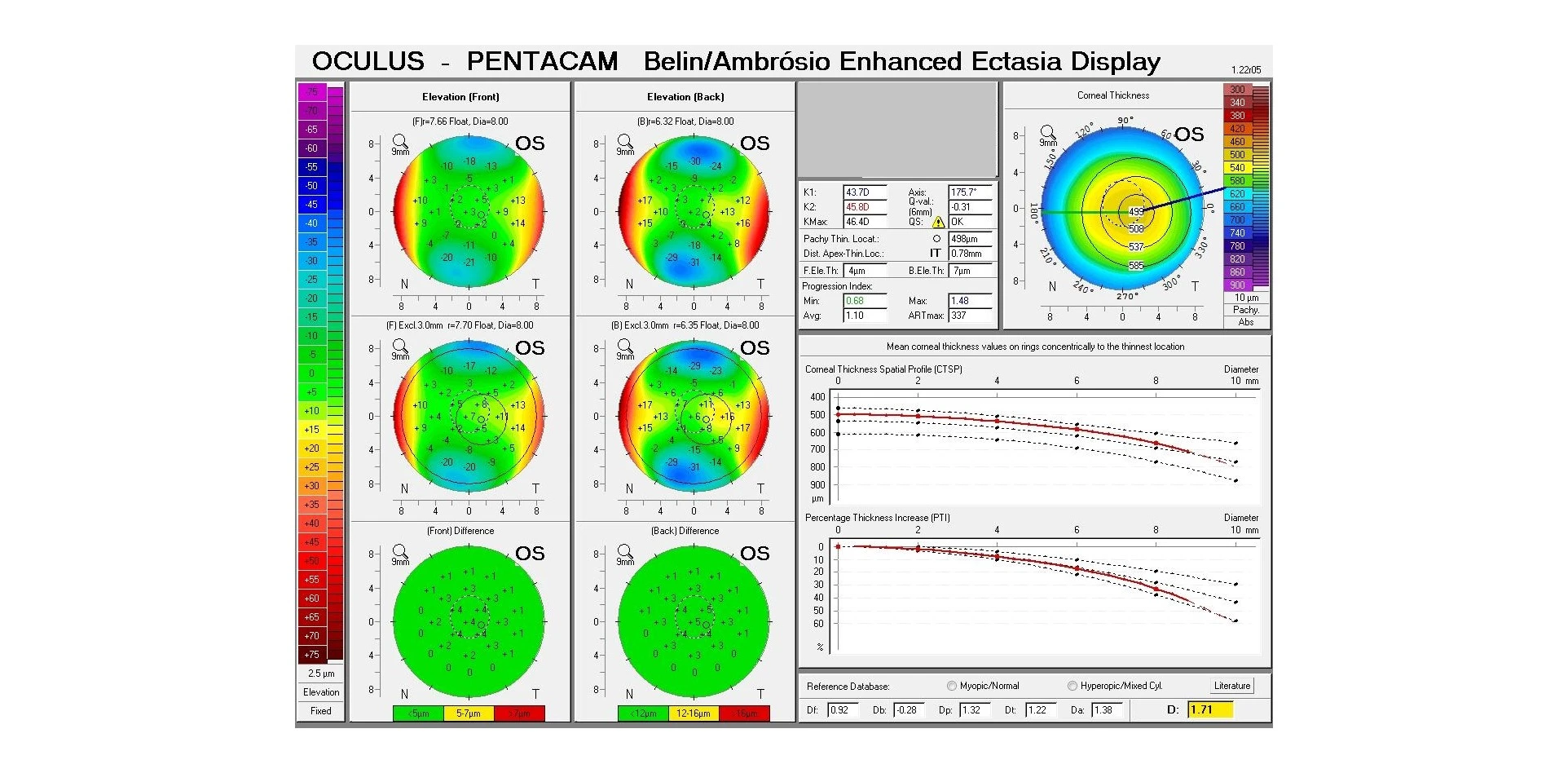
Corneal ectasia is a rare complication in which the cornea progressively thins, steepens and bulges forward, causing increasing myopia, irregular astigmatism and distorted vision. It can be difficult to treat once it develops, which is why careful screening beforehand matters so much.
Regression
Regression is when myopia or astigmatism gradually recurs even after a successful LASIK surgery. It is more common than ectasia and usually milder, and it sometimes leads to an enhancement (touch-up) procedure. Regression has more than one cause: healing responses, the original prescription, and individual biology all play a part, so cross-linking addresses only part of the picture.
By increasing cross-linking within the treated corneal tissue, LASIK Xtra aims to improve biomechanical stability and may reduce refractive regression in selected patients. Whether it prevents post-LASIK ectasia has not been conclusively established.
Who Might Be Considered for LASIK Xtra?
LASIK Xtra may be considered for selected patients who are suitable for LASIK and whose combined corneal measurements suggest that additional biomechanical support may be beneficial.
It is an additional step layered onto the LASIK decision, considered when the expected benefit seems to justify it. It is not offered to make an otherwise unsuitable eye suitable.
In practice, the surgeon may consider Xtra for:
- Patients undergoing LASIK for higher myopic corrections, where more tissue is removed.
- Selected hyperopic (long-sighted) treatments, where regression is a recognised concern.
- Eyes with thinner-than-average corneas that still meet the surgeon's LASIK safety criteria.
- Patients whose combined measurements suggest that additional biomechanical support may be reasonable.
The decision is never made on one number alone.
Corneal thickness on its own does not decide anything; it is read together with the corneal maps, the prescription, how much tissue the planned treatment will remove, and the predicted thickness left behind. Two people with the same glasses prescription can get different advice for this reason.
When LASIK Xtra Does Not Make LASIK Suitable
LASIK Xtra is an additional step for selected LASIK candidates. It is not a substitute for proper screening, and it is not a way to get around LASIK safety thresholds.
If any of the following apply, adding Xtra does not make LASIK the right choice:
- The predicted residual stromal bed (the corneal tissue left after treatment) is inadequate.
- Keratoconus is suspected or confirmed, or there is another sign the cornea is not stable.
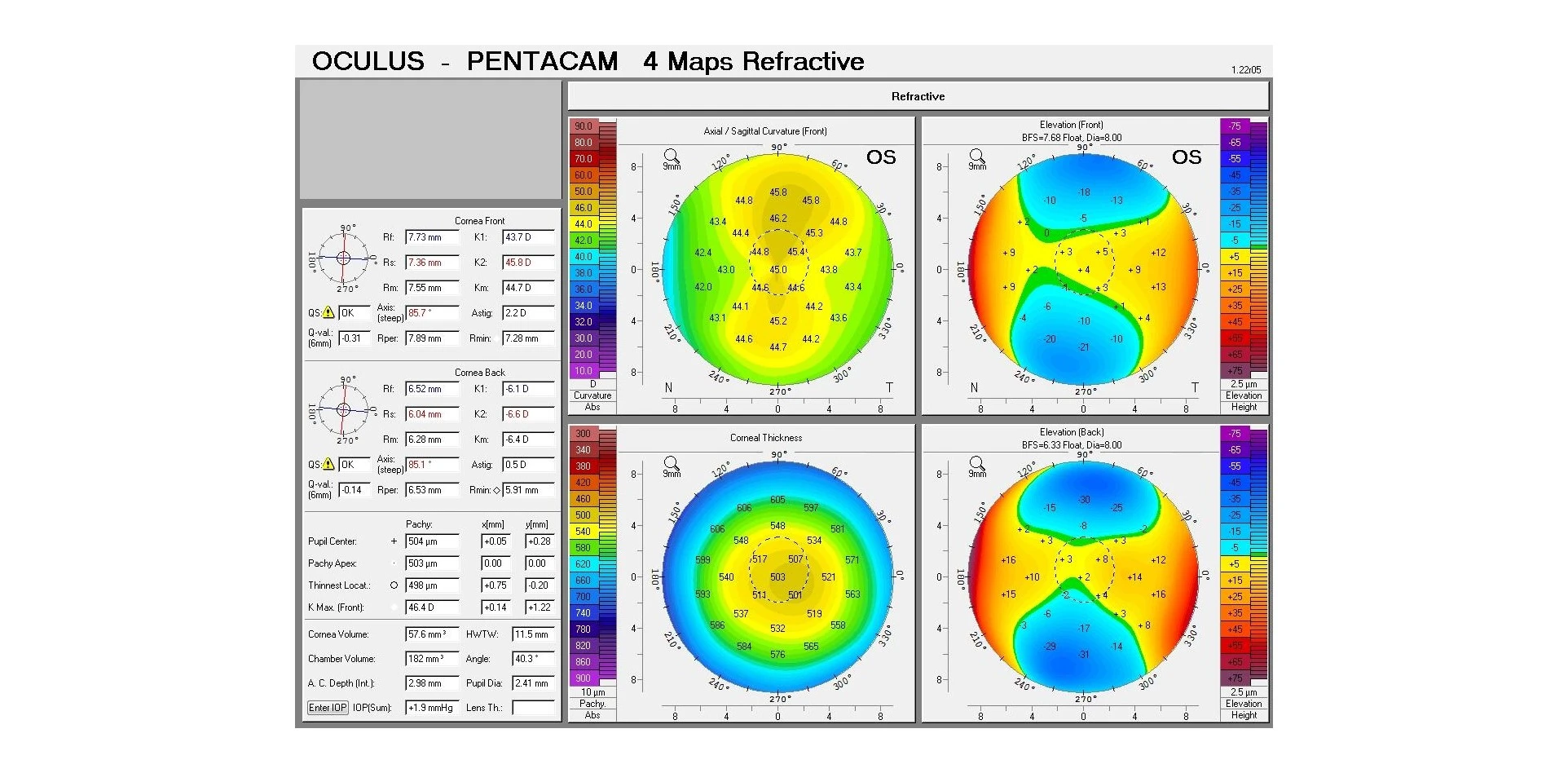
- The corneal maps (topography or tomography) show concerning or irregular patterns.
- The prescription has not been stable.
- The surgeon judges LASIK unsafe for any other reason.
A family history of keratoconus, an irregular corneal scan, or a very young age are treated as reasons for more caution, not as reasons to add Xtra and proceed. In some of these cases the surgeon may advise against LASIK altogether.
Where LASIK is not appropriate, alternatives such as surface ablation or ICL may be considered, depending on the patient's corneal measurements, prescription and overall eye health.
Surface ablation avoids creating a LASIK flap and may be considered for some patients with thinner corneas. ICL corrects vision without removing corneal tissue and may be considered for selected patients with higher prescriptions or corneas unsuitable for laser correction.
Not sure which procedure fits your eyes? Book a suitability assessment to find out what your corneal measurements allow.
How Your Surgeon Decides Whether LASIK Xtra May Help
Because no single measurement decides suitability, the assessment looks at several things together before Xtra is even discussed:
- Corneal thickness.
- Corneal topography and tomography (detailed maps of the cornea's shape and structure).
- Your prescription and the amount of tissue the planned treatment will remove (the planned ablation depth).
- The predicted residual stromal bed after treatment.
- Other biomechanical or clinical findings the surgeon considers relevant.
Only once these are reviewed together does the surgeon form a view on whether LASIK is appropriate at all, and then whether cross-linking is likely to add worthwhile stability for that particular eye.
The LASIK Xtra Procedure at AECS
LASIK Xtra is carried out as part of the LASIK surgery, immediately after the cornea has been reshaped. In general, the steps are:
-
LASIK is performed as usual
The flap is created and the cornea reshaped exactly as in a standard LASIK procedure. All of the vision correction happens at this stage.
-
Riboflavin is applied
VibeX Xtra eye drops, a riboflavin (Vitamin B2) formulation, are applied to the cornea and left to soak.
-
The flap is repositioned and UVA light applied
The flap is laid back in place, and the cornea is then illuminated with ultraviolet A (UVA) light.
-
The collagen cross-links
The light cross-links the collagen fibres within the cornea, making it stronger.
Image request: LASIK Xtra procedure
An original high-resolution photo from AECS showing the LASIK Xtra cross-linking step, preferably the application of riboflavin or the UVA-light treatment. Landscape preferred.
Find out whether LASIK Xtra suits your eyes
Whether cross-linking is added is decided after your cornea has been mapped and measured, by the surgeon who will perform your treatment.
What Does the Evidence Show?
Studies of LASIK Xtra have generally reported visual outcomes, safety and predictability comparable to standard LASIK. Some studies involving patients with high myopia or hyperopia have also reported improved refractive stability or less regression after cross-linking.
Dr Mohamad Rosman, who was one of the first surgeons to do LASIK Xtra in Singapore, co-authored two Singapore-based studies on LASIK Xtra in Asian patients with high myopia. A 2018 study compared LASIK Xtra with standard LASIK and reported comparable safety, predictability and efficacy. A separate 2020 retrospective case series reported outcomes for LASIK Xtra with follow-up of up to three years.
The wider evidence remains mixed. Recent systematic reviews have not established a clear advantage for adding cross-linking to every LASIK procedure, and treatment protocols vary between studies. Longer-term research is also needed, particularly because post-LASIK ectasia is too rare for smaller studies to determine whether LASIK Xtra prevents it.
The evidence therefore supports a selective approach: LASIK Xtra may be considered when a surgeon believes additional biomechanical stability could be useful, rather than being added routinely for every patient.
Book a consultation to discuss whether LASIK Xtra suits your eyes.
Safety, Limitations and Possible Side Effects
Studies have generally reported safety outcomes comparable to standard LASIK, although the additional cross-linking step has its own considerations.
Temporary corneal haze and slightly slower visual recovery have been reported following some LASIK Xtra protocols. The likelihood and clinical significance of these effects can vary according to the treatment protocol and individual eye.
LASIK Xtra also carries the general risks associated with LASIK, including temporary dry eye, glare, halos and rare surgical complications. These are explained in more detail on our LASIK page.
What LASIK Xtra cannot guarantee: that ectasia or regression will not occur, that an enhancement will never be required, or that a patient will remain completely free from glasses.
LASIK Xtra vs Standard Cross-Linking (CXL)
These two procedures use the same basic technique but have different purposes, and patients often confuse them.
| LASIK Xtra | Standard cross-linking (CXL) | |
|---|---|---|
| Purpose | Preventive cross-linking added to vision-correction surgery, to add stability | Treatment for an already-affected cornea, to slow or halt progression |
| Used for | A cornea healthy enough for LASIK | Progressive conditions such as keratoconus or existing ectasia |
| Effect on prescription | The prescription is corrected by the LASIK | Does not correct the prescription, so glasses or contact lenses are usually still needed |
| Protocol | Generally a lower total UVA dose and a shorter soak | A therapeutic protocol aimed at treating a diseased cornea |
If you are looking for information on keratoconus itself, see our page on corneal disease.
LASIK Xtra Cost in Singapore
LASIK Xtra is priced as an addition to the base LASIK fee rather than as a separate operation, since it is performed during the same surgery.
The exact amount depends on your treatment plan and is confirmed at your assessment, once the surgeon has advised whether Xtra is likely to benefit your eyes. Xtra is recommended on clinical grounds, not added by default.
For the base LASIK fee, what it includes, and payment or financing information, see the LASIK page. As with LASIK, cross-linking as part of elective vision correction is not claimable under MediSave.
Frequently Asked Questions
Does LASIK Xtra improve my vision more than normal LASIK?
No. The vision correction comes from the LASIK. The cross-linking step is intended to add stability to the cornea, not to make your eyesight sharper. You should not expect a better visual result simply from adding Xtra.
Is LASIK Xtra worth it?
That depends on your cornea and your prescription, and it is a decision made with your surgeon rather than in advance. For some eyes the added stability is a reasonable trade-off; for others there is little expected benefit, and it is not recommended. The current evidence does not support adding it for everyone.
Does LASIK Xtra hurt, or add much time to the surgery?
The step is done while your eye is already numbed for LASIK, and it adds about two minutes to the procedure.
I was told my corneas are too thin for LASIK. Can Xtra make me eligible?
Not if the cornea is genuinely too thin or the screening raises other concerns. LASIK Xtra does not override the safety limits for LASIK. If LASIK is not suitable, your surgeon can discuss alternatives such as surface ablation or ICL.
Is LASIK Xtra riskier than LASIK?
Overall safety reported in studies is broadly comparable, though the cross-linking step has some considerations of its own, such as transient haze or, in some cases, slightly slower early visual recovery. It is discussed with you as part of the consent process.
Does everyone need LASIK Xtra?
No. Views among surgeons genuinely differ, and the evidence does not establish a benefit for all patients. At AECS it is recommended only when the surgeon judges that the likely benefit justifies the additional step.
Can cross-linking be combined with SMILE or surface ablation, not just LASIK?
Yes. Cross-linking can be paired with other laser vision correction procedures, including SMILE and surface ablation, where the surgeon considers it appropriate.
Our LASIK Doctors
The ophthalmologist who assesses your eyes will advise whether standard LASIK, LASIK Xtra or another vision-correction procedure is appropriate for you.

Dr Chua Wei Han
Founder, Medical Director and Senior Consultant Ophthalmologist
BMedSc (Hons), BMed (Hons), MMed(Ophth), FRCSEd (Ophth), FAMS
Dr Chua subspecialises in cataract and refractive surgery and performs LASIK, SMILE, advanced surface ablation and ICL. He has presented at more than 100 international scientific meetings and published over 25 peer-reviewed papers.

Dr Mohamad Rosman
Senior Consultant Ophthalmologist
MBBS (NUS, Valedictorian), MMed(Ophth), FRCS (Edinburgh), FAMS
Dr Rosman previously headed the Refractive Surgery Department at the Singapore National Eye Centre for nine years and led its Laser Vision Centre. He has performed over 20,000 surgical procedures since 2007 and co-authored peer-reviewed studies on LASIK Xtra in Asian patients with high myopia.
Find out whether LASIK Xtra is suitable for you
At Advanced Eye Clinic & Surgery, we offer up-to-date vision correction treatment options, and LASIK Xtra is one of them. Each treatment is planned around the individual eye, and whether cross-linking is added is a clinical decision made after assessment rather than a routine add-on.
References
- Rajpal RK, et al. LASIK Xtra Provides Corneal Stability and Improved Outcomes. Ophthalmology and Therapy, 2015. PMCID: PMC4675731.
- Brar S, et al. Refractive Surgery With Simultaneous Collagen Cross-Linking. Indian Journal of Ophthalmology, 2021. PMCID: PMC7856924.
- Low JR, et al. Simultaneous Accelerated Corneal Crosslinking and LASIK for the Treatment of High Myopia in Asian Eyes. 2018. PMCID: PMC6062923.
- Lim L, et al. Three-Year Outcomes of Simultaneous Accelerated Corneal Crosslinking and Femto-LASIK for the Treatment of High Myopia in Asian Eyes. 2020. PMCID: PMC7526743.
- Hira S, et al. Comparison of Refractive Surgeries With and Without Corneal Crosslinking: Systematic Review and Meta-analysis. Journal of Cataract & Refractive Surgery, 2024.
- Tian H, et al. Combined Accelerated Crosslinking With LASIK for Myopic Patients: A Systematic Review and Meta-analysis. American Journal of Ophthalmology, 2025.
- Kaiser KP, et al. Eight-Year Results of LASIK With or Without Combined Accelerated Crosslinking in Highly Myopic Eyes. Journal of Cataract & Refractive Surgery, 2026.
- Li J, et al. Evaluation of Stability and Visual Quality Two Years Following FS-LASIK Xtra. BMC Ophthalmology, 2026.
- Chan C, et al. Analysis of Cases and Accuracy of Three Risk-Scoring Systems in Predicting Ectasia After LASIK. Journal of Cataract & Refractive Surgery, 2018.
- Moshirfar M, et al. Ectasia After Corneal Refractive Surgery: A Systematic Review. 2021.