Jun
23
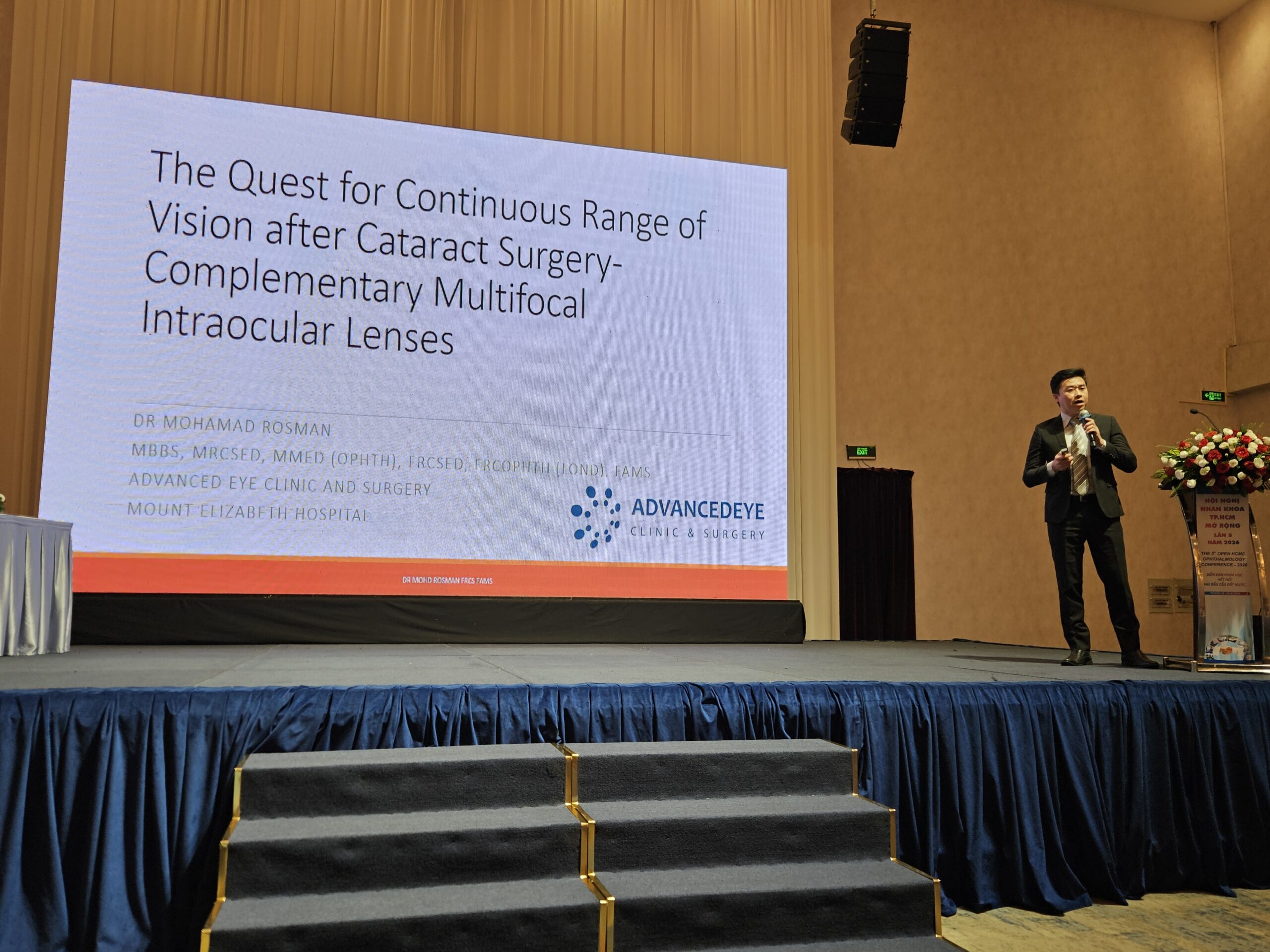
The Quest for Continuous Range of Vision after Cataract Surgery – Complementary Multifocal Intraocular Lenses
0 Comments
Based on Dr Mohamad Rosman’s presentation at the 5th Ho Chi Minh Ophthalmology Conference
On 22 August 2026, Dr Mohamad Rosman participated as an invited speaker at the 5th Ho Chi Minh Ophthalmology Conference in Ho Chi Minh City, Vietnam.
His presentation was titled The Quest for Continuous Range of Vision After Cataract Surgery. It focused on the different intraocular lens approaches used to provide vision at distance, intermediate and near ranges after cataract surgery.
The topic relates to cataract surgery and the selection of intraocular lenses, or IOLs.
Dr Rosman’s main point for patients was that several options may be considered when the aim is to reduce dependence on spectacles after cataract surgery.
What Is a Continuous Range of Vision?
A continuous range of vision refers to vision across distance, intermediate and near ranges, with fewer gaps between them.
Intermediate vision is used for activities such as looking at a computer screen or a vehicle dashboard. Dr Rosman’s presentation highlighted that some patients notice a lack of intermediate vision even when they can see at distance and near.
The development of presbyopia-correcting IOLs has therefore involved different approaches to providing vision across more than one distance.
These approaches include:
- Monofocal lenses
- Bifocal lenses
- Trifocal lenses
- Extended depth of focus lenses
- Complementary intraocular lens combinations
Each uses a different optical approach.
Monofocal Intraocular Lenses
A monofocal IOL has one optical power.
It is usually selected to correct distance vision. Patients will generally require spectacles for near vision when the lens is set for distance.
The single focus distinguishes a monofocal lens from multifocal designs, which create two or more focal points.
Bifocal Intraocular Lenses
Bifocal IOLs provide correction for two main ranges: distance and near.
They were an early approach to multifocality in cataract lens design. However, Dr Rosman’s presentation identified intermediate vision as a limitation of bifocal lenses.
A patient may therefore have distance and near vision but experience a gap at intermediate distances.
Trifocal Intraocular Lenses
Trifocal IOLs provide focal points for:
- Distance vision
- Intermediate vision
- Near vision
The addition of an intermediate focus is intended to address the gap associated with bifocal lenses.
In his presentation, Dr Rosman explained that trifocal lenses provide vision at the three main distances. He also discussed whether separate focal points necessarily produce a continuous transition across all the distances between them.
Extended Depth of Focus Intraocular Lenses
Extended depth of focus, or EDOF, IOLs use a different optical principle.
Instead of creating several separate focal points, an EDOF lens creates a single, elongated focal point. This is intended to increase the depth of focus.
Dr Rosman described the intended range of an EDOF lens as extending from distance to intermediate vision.
His presentation also identified a limitation: near vision may remain insufficient with some EDOF designs.
Why Multifocal Lenses May Cause Glare or Halos
Multifocal IOLs create two or more focal points along the visual axis.
These focal points provide refractive benefit at distance and near, as well as intermediate distances in some designs.
However, each focal point may be associated with secondary out-of-focus images. Dr Rosman explained that these images can result in visual disturbances such as glare or halos.
The possibility of glare and halos is therefore part of the discussion when a multifocal IOL is considered.
Why Gaps in Focus May Still Occur
Dr Rosman presented the development of presbyopia-correcting IOLs as a progression over the past two decades.
The presentation described the following limitations:
| IOL approach | Limitation discussed in the presentation |
| Bifocal IOL | Intermediate vision may be insufficient |
| Trifocal IOL | Provides an intermediate focus, but the range may not be continuous |
| Diffractive EDOF IOL | Near vision may be insufficient, and the range may not be fully continuous |
| EDOF IOL | Near vision may be insufficient |
These limitations led to the discussion of combining IOL designs that place emphasis on different parts of the visual range.
What Are Complementary Intraocular Lenses?
Complementary IOLs are two lens designs intended to be used together.
Dr Rosman’s presentation discussed the Artis Symbiose system as an example. The system consists of two multifocal lens designs:
- A Mid lens that places more emphasis on intermediate vision
- A Plus lens that places more emphasis on near vision
The lenses combine refractive and diffractive optical principles. According to the presentation, they are designed to complement each other when used in opposite eyes.
The intended approach is for one eye to contribute more to intermediate vision while the other contributes more to near vision.
The Principles Behind Complementary IOLs
Dr Rosman’s presentation identified four principles behind the complementary approach:
- Increasing depth of focus at intermediate-to-near distances
- Maintaining contrast across different distances
- Providing continuity between intermediate and near ranges
- Using binocular summation
Binocular summation refers to the visual system using information from both eyes together.
With complementary IOLs, the intended visual ranges of the two lenses overlap. The approach uses the contribution of both eyes rather than relying on one lens design to provide the entire range.
How Complementary IOLs Differ From Traditional Trifocal Lenses
A traditional trifocal lens provides separate focal points for distance, intermediate and near vision.
The complementary approach uses two multifocal lenses with different optical profiles. One places more emphasis on intermediate vision and the other on near vision.
Dr Rosman’s presentation compared these approaches in terms of the continuity between intermediate and near distances.
The presentation focused specifically on the optical concept and the use of two lenses intended to complement each other.
Patient Factors Discussed in the Presentation
Dr Rosman’s slides also addressed patient and eye factors considered when using a complementary IOL system.
The patient-related considerations included:
- Long-sightedness
- No previous refractive laser surgery
- Understanding the intended visual range of the lenses
The eye-related considerations included:
- A straightforward cataract
- No significant eye pathology
- No signs of dry eye
- Normal corneal topography
These factors were discussed in relation to patient selection for the lens approach presented.
Planning Considerations Discussed by Dr Rosman
The presentation included several points intended for ophthalmologists when planning surgery.
These included:
- Assessing and correcting corneal astigmatism
- Selecting an IOL intended to minimise residual astigmatism
- Planning which complementary lens to implant first
- Using a digital toric alignment system where required
- Creating a circular capsular opening of the planned size
- Removing viscoelastic material from behind the IOL
These are surgical planning considerations rather than decisions that patients make independently.
What Patients Can Take From the Presentation
The presentation showed that spectacle reduction after cataract surgery can be approached in several ways.
Monofocal, bifocal, trifocal and EDOF lenses use different optical principles. They also address distance, intermediate and near vision differently.
Complementary IOLs are another approach. They use two lens designs intended to contribute to different parts of the visual range when the eyes work together.
Dr Rosman’s presentation also emphasised patient selection, the condition of the eye and surgical planning.
Patients considering an IOL should discuss the available options with their ophthalmologist. The discussion can include which visual distances are being addressed and the limitations associated with the proposed lens design.
More information is available on the cataract surgery with intraocular lenses page.
Frequently Asked Questions
What is the difference between monofocal and multifocal IOLs?
A monofocal IOL has one optical power and is usually set for distance vision.
A multifocal IOL creates two or more focal points. These may provide vision at distance, intermediate or near ranges, depending on the lens design.
What is the difference between bifocal and trifocal IOLs?
A bifocal IOL provides focal points for distance and near vision.
A trifocal IOL adds an intermediate focal point.
What is an EDOF IOL?
An EDOF IOL creates an elongated focal point to increase the depth of focus.
Dr Rosman’s presentation described EDOF lenses as providing a range from distance to intermediate vision, with near vision remaining a possible limitation.
Why can multifocal IOLs cause glare or halos?
Multifocal IOLs create more than one focal point. Each focal point may be associated with secondary out-of-focus images.
These images can result in visual disturbances such as glare or halos.
What is a complementary IOL approach?
A complementary approach uses two IOL designs with different optical profiles.
In the system discussed by Dr Rosman, one lens places more emphasis on intermediate vision and the other on near vision. The lenses are designed to be used together.
Is a complementary IOL suitable for every patient?
Dr Rosman’s presentation discussed patient selection before using this approach.
The factors included the type of cataract, previous refractive laser surgery, dry eye, corneal topography and the presence of other eye conditions.
This article summarises information presented by Dr Mohamad Rosman at the 5th Ho Chi Minh Ophthalmology Conference. It provides general information and does not replace an eye examination or individual medical advice from an ophthalmologist.
Disclosure
In the conference presentation, Dr Rosman disclosed consultancy, lecture and research relationships with several ophthalmic companies.
The presentation used the Artis Symbiose system to explain the complementary multifocal IOL concept. This article does not include the lens outcome data, patient cases, product comparisons or personal surgical results shown in the professional presentation.
Source
Dr Mohamad Rosman. The Quest for Continuous Range of Vision After Cataract Surgery: Complementary Multifocal Intraocular Lenses. Presented at the 5th Ho Chi Minh Ophthalmology Conference, Ho Chi Minh City, Vietnam, 22 August 2026.
Categories:
Uncategorized