
23
Oct
Macula hole repair without gas tamponade
Categories: Uncategorized 0 CommentsA macula hole is a retinal break located in the centre of the retina resulting in loss of fine vision. This most commonly occurs in the elderly population, but can also develop in high myopia, after trauma or secondary to tractional membranes on the macula surface.
The typical method of surgical repair , first described by Kelly and Wendel, is via a pars plana vitrectomy during which the vitreous gel is first removed. Then the fine taut membrane around the macula hole, called the internal limiting membrane is peeled off. A gas bubble is then injected into the eye and the bubble helps with the bridging of the edges of the macula hole to aid in closure. While the bubble is within the eye, the patient has to adopt a face down posture to maximise the gas tamponade at the macula and to prevent secondary complications of the gas such as increased eye pressure and cataract formation.
In this updated surgical technique, Dr Lee is able to create a flap of the internal limiting membrane that is draped across the macula hole, covering the macula hole. The flap is stabilized using perfluorocarbon liquid as well as a dispersive viscoelastic so that it remains in position after surgery. This technique has been shown to be comparable to the conventional surgical technique with gas tamponade – Szeto et al. reported that the no-gas ILM flap technique achieved a 95.2% macular hole closure rate, which is comparable to the 94.1% rate seen in conventional surgery using gas tamponade
Without the need for gas tamponade, there is faster visual rehabilitation and negates the need for postoperative face down posturing, making the postoperative process much more comfortable for the patient. Furthermore, without a gas bubble in the eye, the potential complications of raised intraocular pressure and cataract formation are also avoided.
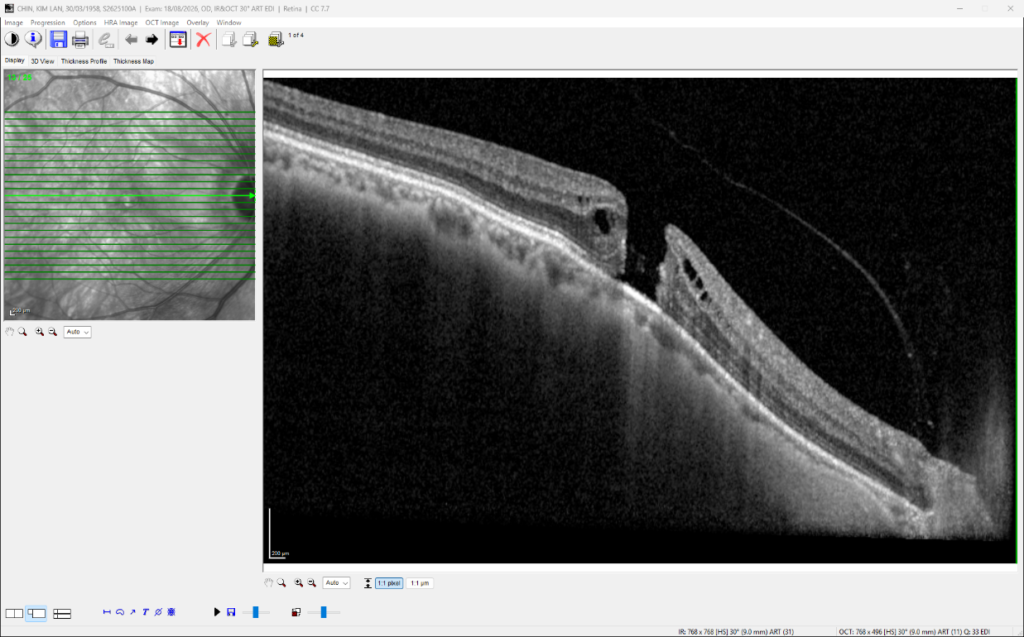
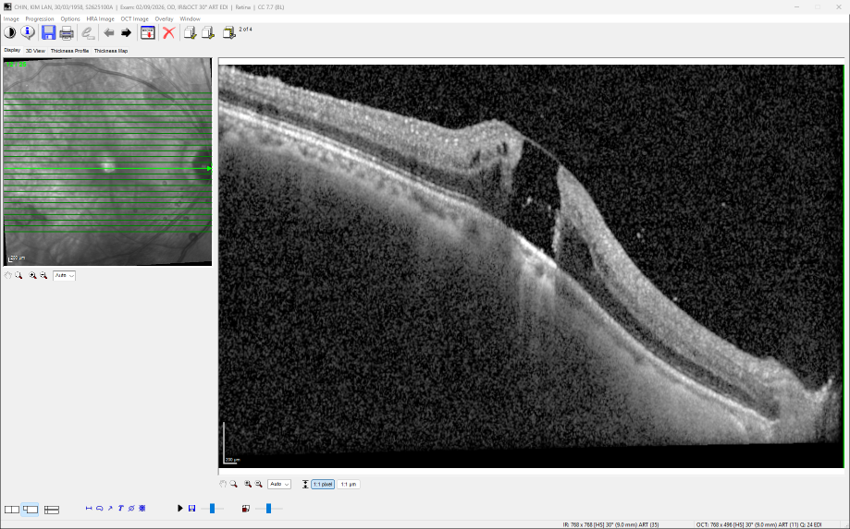
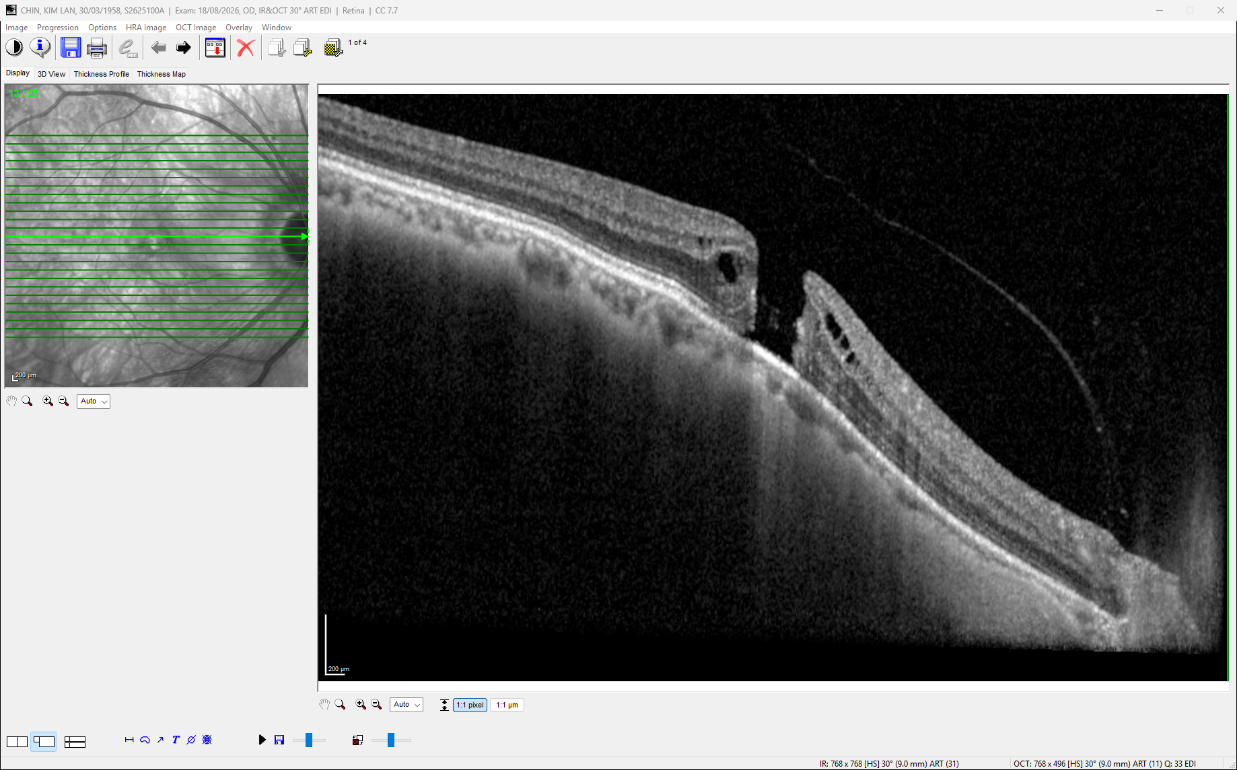
The internal limiting membrane (ILM) flap can be seen covering the macula hole.
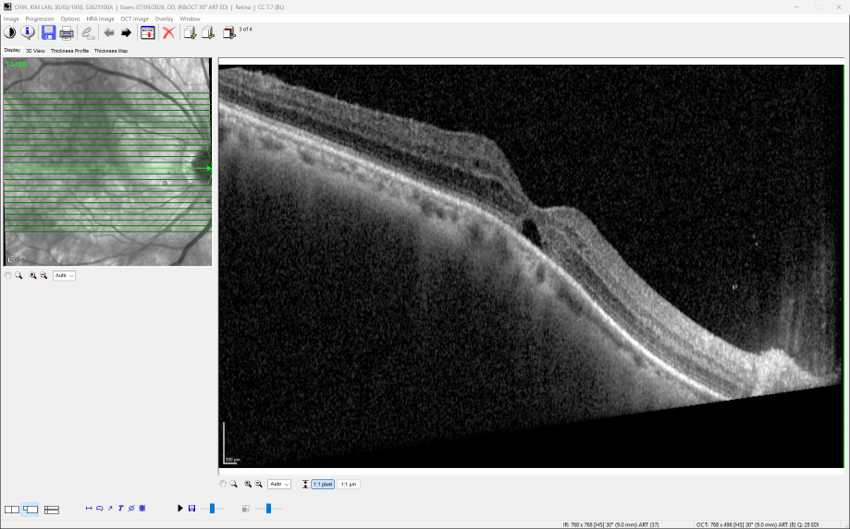
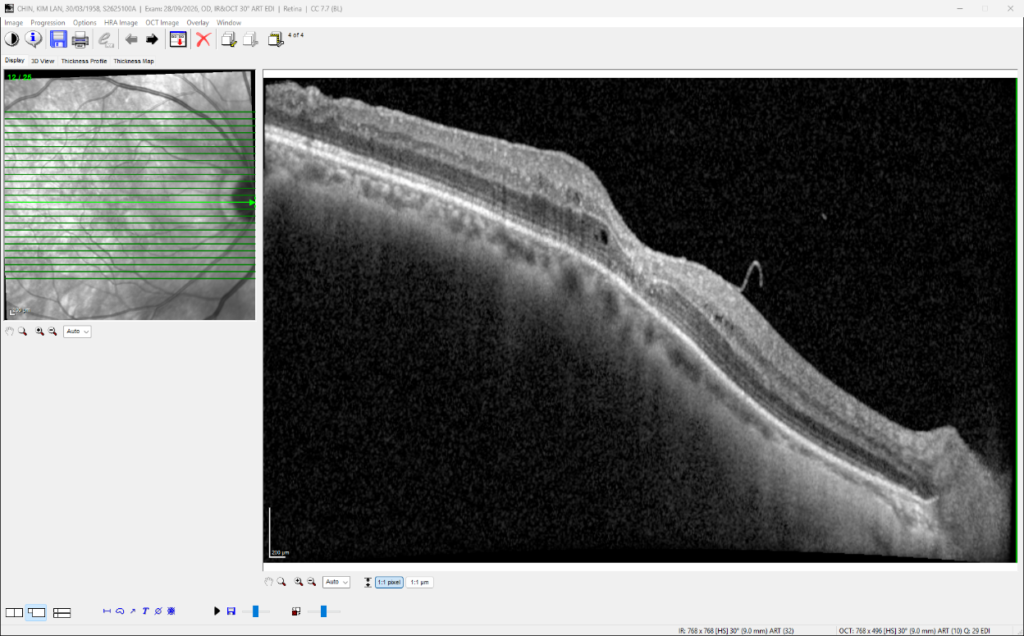
At 1 month after surgery, the macula hole has closed fully and the edge of the ILM flap is still seen on the surface of the retina.
References
Kelly NE, Wendel RT. Vitreous surgery for idiopathic macular holes. Results of a pilot study. Arch Ophthalmol. 1991;109(5):654–659
Eckardt C, Eckert T, Eckardt UT, Porkert U, Gesser C. Macular hole surgery with air tamponade and optical coherence tomography-based duration of face-down positioning. Retina. 2008;28(8):1087–1096
Stopa M, Ciesielski M, Rakowicz P. Macular hole closure without endotamponade application. Retina. Published online May 22, 2020
Lally DR, Kasetty MA. Closure of small macular holes using vitrectomy surgery with internal limiting membrane peeling without the use of intraocular gas tamponade: broadening the understanding of macular hole pathophysiology. Retin Cases Brief Rep. 2020;14(2):104–109
Ophthalmol Retina 2025 Nov;9(11):1034-1043.
Macular Hole Closure by Internal Limiting Membrane Flap without Gas Tamponade versus Conventional Surgery: A Comparative Study
Simon K H Szeto 1, Julia T W Lam 2, Amy H Y Yu 2, Christopher M K Pang 2, Timothy P H Lin 2, Vivian W K Hui 2, Ken K Tsang 2, Jason C K Chan 2, Li Jia Chen 3, Timothy Y Y Lai 4, Shaheeda Mohamed 2, Chi Wai Tsang 2