
Laser Vision Correction
LASIK Surgery in Singapore
LASIK is the most widely performed laser vision correction procedure in the world. It reshapes the cornea to correct short-sightedness, long-sightedness and astigmatism, and is performed with numbing eye drops — most patients feel pressure rather than pain during treatment, followed by several hours of grittiness, watering or light sensitivity.
At Advanced Eye Clinic & Surgery, LASIK in Singapore is performed by experienced refractive surgeons, with every treatment planned and carried out by the surgeon you meet at your first consultation.
- Procedure time
- ~10 minutes per eye
- Anaesthesia
- Numbing eye drops only
- Sensation
- Pressure rather than pain for most patients
- Back to work
- 1–2 days for most patients
- Aim
- Reduced dependence on glasses and contact lenses
- Suitable from
- Age 21 for most patients; 18–21 case by case with a stable prescription
On this page
What Is LASIK?
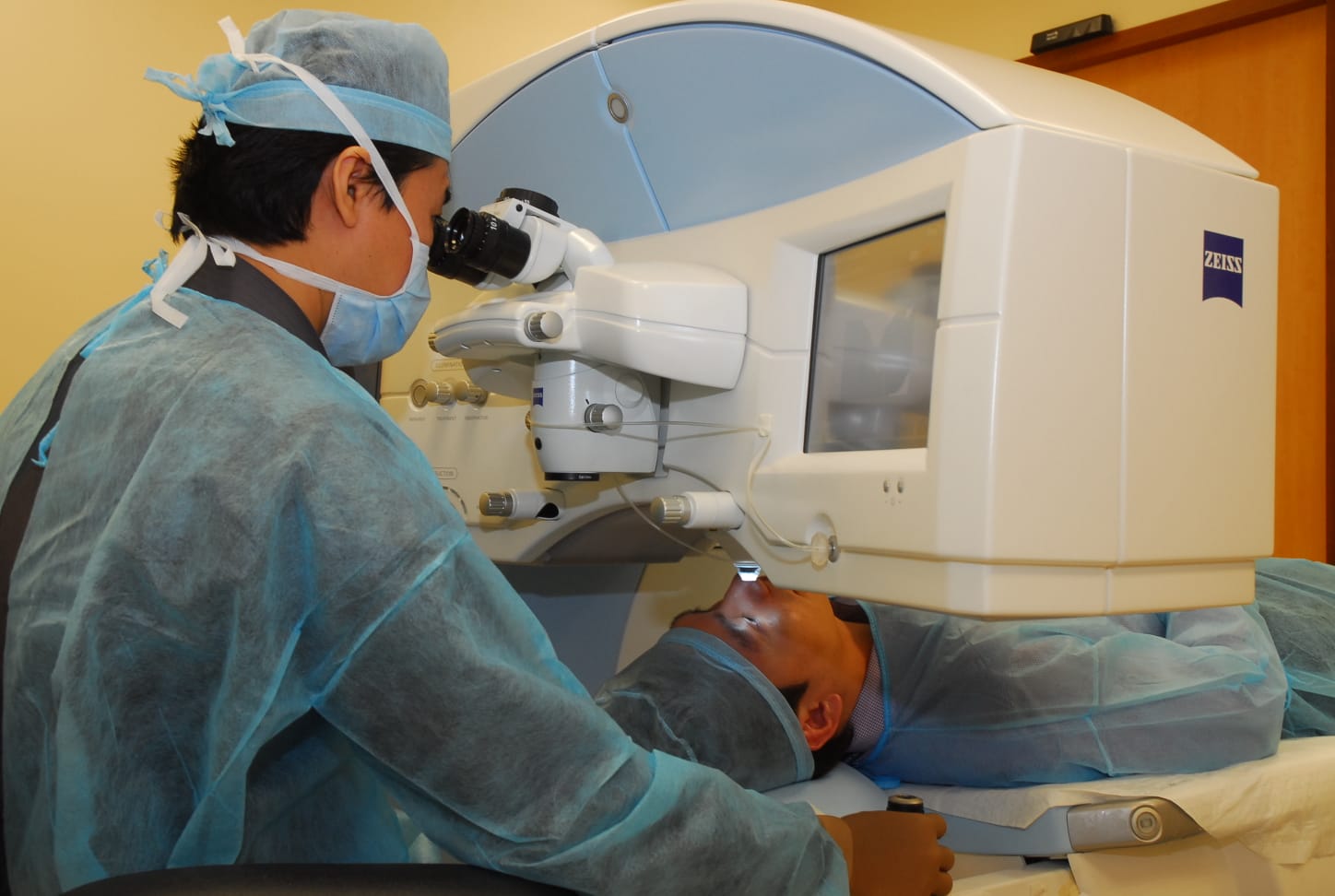
LASIK (laser-assisted in situ keratomileusis) corrects your vision by changing the shape of the cornea — the clear front window of the eye — so that light focuses precisely on the retina instead of in front of or behind it.

The procedure has two steps. First, a femtosecond laser creates a thin, hinged flap on the surface of the cornea. The surgeon gently folds this flap back, then a second laser — the excimer laser — removes a microscopic, pre-calculated amount of tissue to reshape the cornea. The flap is laid back in place, where it seals naturally without stitches.


At AECS, all LASIK is bladeless: the flap is created using a femtosecond laser rather than a mechanical microkeratome, allowing its dimensions and position to be planned as part of the treatment. The flap is what distinguishes LASIK from its sibling procedures — SMILE/SMILEPro removes tissue through a keyhole incision with no flap, and surface ablation (PRK/LASEK/transPRK) works on the corneal surface with no flap at all.
What LASIK Corrects
Myopia (short-sightedness)
If distant objects are blurry while near objects stay clear, LASIK flattens the central cornea slightly so light focuses on the retina rather than in front of it. Short-sighted laser treatment is the most common reason patients come to us — unsurprising in Singapore, where more than 80% of young adults are myopic.
There's no single cut-off. LASIK is usually avoided above about −10.00D, though it can still be appropriate at higher prescriptions if your cornea is thick enough. Corneal thickness, not the number on your glasses, decides this — which is why the measurement is taken before any recommendation.
Hyperopia (long-sightedness)
If near objects strain your eyes while distance is more comfortable, long-sighted laser treatment steepens the cornea so light focuses further forward.
LASIK can be used for selected cases of hyperopia, whereas SMILE is generally used for myopia and myopic astigmatism. Most excimer lasers treat hyperopia up to approximately +5.00D. Suitability also depends on corneal measurements and other eye factors, which your surgeon assesses in person.
Astigmatism
An unevenly curved cornea scatters light and blurs vision at every distance. LASIK reshapes the cornea into a more regular curve, and astigmatism is routinely corrected in the same treatment as myopia or hyperopia — up to approximately −5.00D with current laser platforms.
What LASIK doesn't correct: presbyopia
LASIK corrects the shape of your cornea — it does not stop the natural ageing of the eye's internal lens. From the mid-40s onward, most people gradually lose the ability to focus up close (presbyopia, or "lao hua"), and this happens whether or not you've had LASIK.
Even with a good distance-vision result, you may still need reading glasses in your 40s or 50s. If reading vision is your main concern, see our presbyopia treatment options instead.
What Result Can I Expect?
The intended outcome of LASIK is reduced dependence on glasses or contact lenses.
The exact result varies from eye to eye — most patients achieve good unaided vision for daily activities, but some may still choose glasses for selected tasks such as night driving.
Your ophthalmologist will discuss the realistic range of outcomes for your specific prescription and corneal measurements at your assessment, before you decide anything.
Am I Suitable for LASIK?
Most healthy adults with a stable prescription are good candidates. As a general guide, LASIK may be right for you if you:
- Are at least 21 years old (18–21 considered case by case, if your prescription has been stable)
- Have had a stable prescription for at least 12 months
- Have adequate corneal thickness (measured at your assessment)
- Have no active eye disease such as glaucoma, cataract, keratoconus or significant eye inflammation
- Are not pregnant or breastfeeding (hormonal changes temporarily shift your prescription)
- Fall within the treatable prescription ranges above
- Are not taking acne medication such as isotretinoin
LASIK may not be suitable if you have keratoconus or a family history of it, severe dry eye, an autoimmune condition, or are on immunosuppressant medication, uncontrolled diabetes, an active eye infection, or unusually large pupils that raise the risk of night-vision symptoms. None of these are judgments you need to make yourself — the assessment exists precisely to check each one.
Can I get LASIK if I have dry eyes?
Mild or treatable dry eye does not automatically rule out LASIK. However, significant ocular-surface disease may need to be treated first, and may affect which vision-correction procedure is recommended — a flap-free option such as SMILE or surface ablation disturbs fewer corneal nerves and is sometimes the better fit. LASIK does tend to worsen dryness during the healing period, and for some patients dry-eye symptoms can persist longer, which is exactly why your tear film is assessed before any recommendation is made.
When LASIK isn't the right fit
- Thin corneas — there may not be enough tissue to reshape safely. Surface ablation works on the surface and preserves more corneal depth.
- High myopia — beyond the laser-treatable range, an Implantable Collamer Lens (ICL) adds a lens instead of removing tissue, and often gives better visual quality for high prescriptions.
- Contact sports and high-risk occupations — rugby, martial arts, military service and similar environments carry a small risk of dislodging the corneal flap through direct trauma. SMILE or surface ablation, neither of which creates a flap, may be recommended instead.
If LASIK isn't right for your eyes, we'll tell you plainly and explain what is.
Find out whether LASIK suits your eyes
A suitability assessment maps your cornea, measures its thickness and confirms which vision correction procedure is right for you — before any decision is made.
The LASIK Procedure, Step by Step
-
Before surgery: the LASIK assessment
Everything starts with a detailed suitability assessment, which takes around one to two hours. We map the shape of your cornea (corneal topography), measure its thickness, pupil size, your exact prescription, and dilate your pupils to examine the retina.
A few practical notes:
- Stop contact lenses beforehand — soft lenses for at least one week, hard/RGP lenses for around 2 weeks. Lenses subtly mould the cornea, and the measurements must reflect its natural shape.
- Don't drive to the assessment. The dilating drops blur your near vision for four to six hours and make bright light uncomfortable — bring sunglasses.
- Bring your current glasses or your latest prescription.
After the tests, your surgeon reviews the results with you and confirms whether LASIK — or one of its alternatives — is the right procedure for your eyes, occupation, and lifestyle.
-
During surgery
On the day, expect to be at the clinic for around two hours in total, though the laser treatment itself takes roughly 10 minutes per eye. Numbing drops mean most patients feel pressure rather than pain.
A small device keeps your eyelids comfortably open, the femtosecond laser creates the flap in seconds, and you focus on a fixation light while the excimer laser reshapes the cornea. The laser tracks your eye continuously and pauses if you move outside its range, and your surgeon talks you through each step as it happens.

LASIK treatment illustration. -
After surgery
Your vision will be misty for the first few hours, and your eyes may feel gritty, watery and light-sensitive once the numbing drops wear off — this usually settles within the day. Arrange for someone to take you home or take a taxi; you cannot drive yourself.
You'll go home with antibiotic and lubricating drops, plus a protective shield to wear while sleeping for the first few nights so you don't rub your eyes.
LASIK Recovery Timeline
First 24 hours
Many patients notice a marked improvement in unaided vision by the following day, although clarity may fluctuate during the early healing period. Rest, use your drops on schedule, and avoid screens for extended periods on day one. Your first follow-up review is the day after surgery.
First week
Most people return to desk work within one to two days. Avoid rubbing your eyes, eye makeup, swimming pools and dusty environments. Flying is generally fine within a few days. Follow-up review at the one-week mark.
First month and beyond
Vision continues to sharpen and stabilise over the first few weeks. Keep sunglasses on outdoors, hold off on swimming and contact sports for about a month, and avoid rubbing your eyes for at least two weeks. Reviews at one month and around three months complete the standard schedule.
Any residual fine-tuning, if ever needed, is considered only after your prescription has fully stabilised — typically from three months.
When to call us urgently: contact the clinic promptly if you develop increasing pain, worsening redness, discharge or a sudden reduction in vision. These are different from the expected grittiness and fluctuation of normal healing, and early review matters.
Is LASIK Safe? Risks and Complications
LASIK has been performed for several decades and is generally considered safe for appropriately selected patients. Like any surgery, it can cause side effects and rare complications, and you deserve the full picture before deciding.
Common side effects
- Dry eyes — the most common side effect, affecting most patients to some degree during healing. Usually managed with lubricating drops. For most patients, symptoms improve over the months after surgery, but some experience persistent dryness, particularly if dry eye was present beforehand.
- Halos, glare and starbursts at night — most noticeable in the first weeks, especially around car headlights. These typically fade as the eye heals, though a minority of patients experience longer-lasting night-vision symptoms.
- Fluctuating vision — mild day-to-day variation is normal while the eye heals.
Most side effects improve during healing, but persistent symptoms and rare serious complications can occur.
Rare complications
Serious complications after LASIK are uncommon, and most are treatable when identified early — which is what the structured follow-up schedule exists for. They include:
- Flap-related problems — displacement, wrinkles or epithelial ingrowth (surface cells growing beneath the flap)
- Diffuse lamellar keratitis — significant inflammation beneath the flap
- Infection
- Corneal ectasia — progressive weakening and bulging of the cornea, the main reason corneal thickness and shape are screened so carefully beforehand
- Under- or over-correction — refinable with an enhancement procedure once the prescription is stable. Enhancements are uncommon, and the likelihood rises with higher astigmatism, particularly beyond −2.50D
- Loss of best-corrected visual acuity or visual quality — rare, but the most meaningful measure of harm, which is why it belongs in this list rather than a narrower discussion of "blindness"
Can LASIK cause blindness?
Severe permanent vision loss after LASIK is rare, but serious complications are possible. These can include infection, corneal ectasia, significant inflammation and loss of visual quality.
Careful screening and early treatment of complications reduce the risk — but no surgical procedure is risk-free, and anyone who tells you otherwise is not giving you the full picture.
LASIK Cost in Singapore
LASIK in Singapore generally ranges from around $3,000 to $8,000 for both eyes across the market, depending on the clinic, technology and surgeon seniority.
AECS provides a personalised, all-inclusive quote at your suitability assessment, once your surgeon has confirmed which procedure is right for your eyes — because the answer to "how much" depends on what your eyes actually need.
What the fee covers
Our LASIK fee covers the surgical procedure itself. Your suitability assessment, post-operative reviews and medications are billed separately.
When comparing clinics, ask what each quote includes. Some bundle consultations and follow-ups into a single headline price and some don't, and the surgeon's experience matters more than either.
Is LASIK claimable under MediSave or insurance?
No — LASIK is an elective procedure, so it is not MediSave-claimable and is generally not covered by standard insurance policies. The narrow exception under MOH rules applies when there is a refractive difference of at least 300 degrees between your eyes combined with a genuine intolerance to glasses and contact lenses; your surgeon can advise whether you qualify.
Some corporate insurance plans include LASIK as a benefit — worth checking with your HR or insurer before your assessment.
LASIK vs SMILE vs PRK vs ICL
LASIK is one of four vision correction procedures we offer, and the right one depends on your eyes rather than on marketing. A short comparison:
| Procedure | How it works | Best suited for | Recovery |
|---|---|---|---|
| LASIK | Corneal flap + excimer laser reshaping | Wide range of prescriptions; fast visual recovery | Back to work in 1–2 days |
| SMILEPro | Lenticule removed through keyhole incision, no flap | Contact sports, dry-eye-prone patients | 1–2 days; slightly slower to fully stabilise |
| Surface ablation (PRK/transPRK) |
Laser applied to corneal surface, no flap or incision | Thin corneas, high-trauma occupations, dry eyes | 5–7 days downtime; vision stabilises over weeks |
| ICL | Implantable lens added, no tissue removed | Very high myopia, corneas unsuitable for laser | 1–2 days; reversible |
For laser eye surgery in Singapore, no single procedure is "best" — each wins for a different eye.
Patients with thinner or borderline corneas may also be offered LASIK Xtra, which strengthens the cornea with cross-linking at the time of surgery.
Why Choose Advanced Eye Clinic for LASIK
Choosing a LASIK clinic in Singapore ultimately comes down to who plans your treatment and who holds the laser.
At AECS, the surgeon who assesses your eyes is the surgeon who performs your procedure and reviews you afterwards — there is no hand-off. Our refractive surgeons have performed more than 100,000 surgeries, and because we offer LASIK, SMILEPro, surface ablation and ICL under one roof, the recommendation you receive is based on your eyes, not on the one procedure a clinic happens to sell.
Our LASIK technology
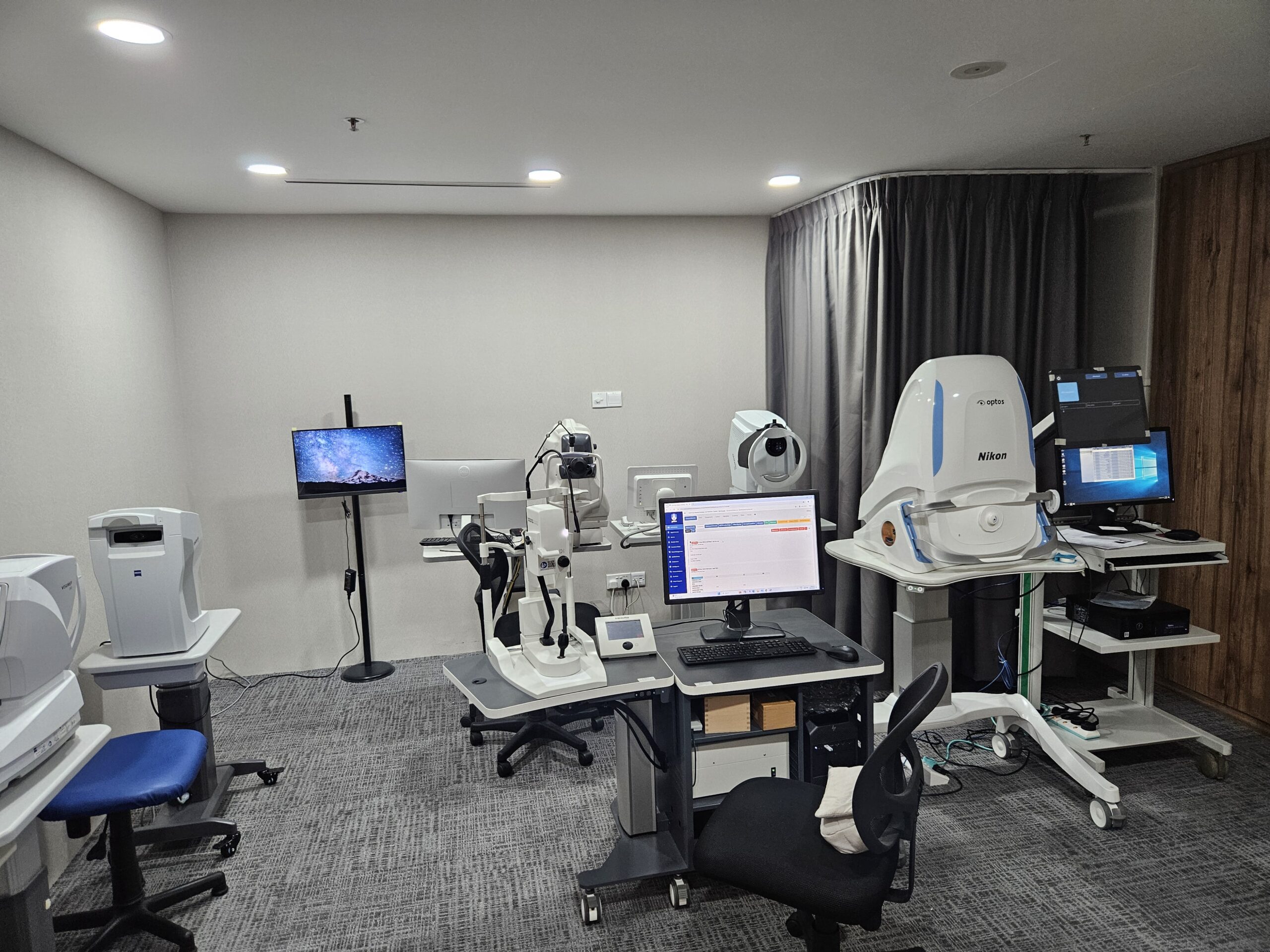
Flap creation at AECS is performed with the Zeiss Visumax 800 or Alcon FS 200, and corneal reshaping with the Amaris 1050 or Alcon EX500, which tracks eye movement continuously throughout treatment. Treatments are wavefront-optimised, which adjusts the laser profile across the cornea to reduce the higher-order aberrations that cause glare and halos at night.
In plain terms: the first laser makes bladeless LASIK possible, and the second makes the reshaping accurate to fractions of a micron — a human hair is roughly 70 microns thick.
Frequently Asked Questions
Is LASIK painful?
Numbing drops mean most patients feel pressure rather than pain during the procedure itself. Expect a few hours of grittiness, watering and light sensitivity afterwards, which usually settles the same day.
Can both eyes be treated on the same day?
Yes — this is standard practice today and keeps your downtime to a single recovery. If you prefer to treat one eye at a time, your surgeon can accommodate that.
Is LASIK permanent?
The corneal reshaping is permanent. Your eyes still age naturally, so presbyopia (reading difficulty from the mid-40s) and cataracts can develop later exactly as they would without LASIK, and a small proportion of patients may need an enhancement once the prescription stabilises.
Will I still need reading glasses when I'm older?
Very likely, yes — from the mid-40s, presbyopia affects everyone regardless of LASIK. Your distance vision correction remains; it's the eye's internal lens that ages.
What happens if I blink or move during the procedure?
A small device holds your eyelids comfortably open, so you cannot blink onto the treatment area, and the laser tracks your eye continuously — pausing if your eye moves outside its range, then resuming when alignment is restored.
Can I have cataract surgery after LASIK?
Yes. LASIK does change how your lens implant power is calculated, so keep your LASIK treatment records and share them with your cataract surgeon when the time comes.
Is LASIK claimable under MediSave?
No. LASIK is elective and not MediSave-claimable, apart from a narrow MOH exception for a large prescription difference between the eyes combined with intolerance to glasses and contact lenses.
How much does LASIK cost at AECS?
Market rates in Singapore range from roughly $3,000 to $8,000 for both eyes.
At AECS, your exact fee is confirmed at your suitability assessment, once your surgeon has verified which procedure suits your eyes.
Our LASIK Doctors

Dr Chua Wei Han
Founder, Medical Director and Senior Consultant Ophthalmologist
BMedSc (Hons), BMed (Hons), MMed(Ophth), FRCSEd (Ophth), FAMS
Dr Chua founded Advanced Eye Clinic & Surgery and sub-specialises in cataract and refractive surgery, performing LASIK, SMILE, advanced surface ablation and ICL using current femtosecond and excimer laser technology.
He graduated as the top medical student with honours from the University of Newcastle, Australia, and is a fellow of the Royal College of Surgeons, Edinburgh and the Academy of Medicine, Singapore.
He has presented at more than 100 international scientific meetings, published over 25 peer-reviewed papers spanning refractive errors, LASIK and dry eye treatment, and has served as an investigator in US FDA clinical trials.

Dr Mohamad Rosman
Senior Consultant Ophthalmologist
MBBS (NUS, Valedictorian), MMed(Ophth), FRCS (Edinburgh), FAMS
Dr Rosman was Head of the Refractive Surgery Department at the Singapore National Eye Centre for nine years, where he was in charge of the Laser Vision Centre and trained many of Singapore's eye surgeons in LASIK, SMILE, ICL and cataract surgery. He has published many peer-reviewed articles and book chapters on refractive surgery, is a key opinion leader on refractive surgery and is regularly invited to speak in the media, and at local and international conferences on various refractive surgery topics.
He has performed over 20,000 surgical procedures since 2007, completed advanced refractive surgery fellowships at SNEC and the VISSUM Eye Institute in Spain, and has served as the Singapore Medical Council's subject-matter expert for refractive surgery since 2014. He consults in English, Mandarin, Malay and Bahasa Indonesia.
Speak to a refractive surgeon
The same ophthalmologist who assesses your eyes plans your treatment, performs it and reviews you afterwards. Start with a suitability assessment at Mount Elizabeth Medical Centre.